标题:How to understand acoustic radiaton impedance in the case of infinite baffle?
I'm a beginner and hope to learn from you all.
1. How to understand and derive the impedance of acoustical radiation in the case of infinite baffle?
2. If we consider the pressure acted on the diaphram, should we consider both the front and the back sides?
3. How to determine/derive/interpret the phase relationship between the air pressure variation and the air volume velocity?
Thank you so much!
非常棒的三个基本的声学问题.
对于我来说还做不到不翻书就回答楼主,不过先占一楼,回头翻翻书尝试回答一下.
PS:Can you reading the reply by Chinese?
刚刚看到其它的帖子,原来是可以看中文的,呵呵.
Acoustic impedance
The acoustic impedance Z (or sound impedance) is a frequency f dependent parameter and is very useful, for example, for describing the behaviour of musical wind instruments. Mathematically, it is the sound pressure p divided by the particle velocity v and the surface area S, through which an acoustic wave of frequency f propagates. If the impedance is calculated for a range of excitation frequencies the result is an impedance curve. Plane, single-frequency traveling waves have acoustic impedance equal to the characteristic impedance divided by the surface area, where the characteristic impedance is the product of longitudinal wave velocity and density of the medium . Acoustic impedance can be expressed in either its constituent units (pressure per velocity per area) or in rayls.

Note that sometimes vS is referred to as the volume velocity.
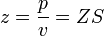
The specific acoustic impedance z is the ratio of sound pressure p to particle velocity v at a single frequency. Therefore
Distinction has to be made between:
- the characteristic acoustic impedance Z0 of a medium, usually air (compare with characteristic impedance in transmission lines).
- the impedance Z of an acoustic component, like a wave conductor, a resonance chamber, a muffler or an organ pipe.
非常棒的三个基本的声学问题.
对于我来说还做不到不翻书就回答楼主,不过先占一楼,回头翻翻书尝试回答一下.
PS:Can you reading the reply by Chinese?
以下是引用水仙在2008-07-09 16:09:08的发言:
先看一下声阻的定义:
Acoustic impedance
The acoustic impedance Z (or sound impedance) is a frequency f dependent parameter and is very useful, for example, for describing the behaviour of musical wind instruments. Mathematically, it is the sound pressure p divided by the particle velocity v and the surface area S, through which an acoustic wave of frequency f propagates. If the impedance is calculated for a range of excitation frequencies the result is an impedance curve. Plane, single-frequency traveling waves have acoustic impedance equal to the characteristic impedance divided by the surface area, where the characteristic impedance is the product of longitudinal wave velocity and density of the medium . Acoustic impedance can be expressed in either its constituent units (pressure per velocity per area) or in rayls.
Note that sometimes vS is referred to as the volume velocity.
The specific acoustic impedance z is the ratio of sound pressure p to particle velocity v at a single frequency. Therefore
Distinction has to be made between:
- the characteristic acoustic impedance Z0 of a medium, usually air (compare with characteristic impedance in transmission lines).
- the impedance Z of an acoustic component, like a wave conductor, a resonance chamber, a muffler or an organ pipe.
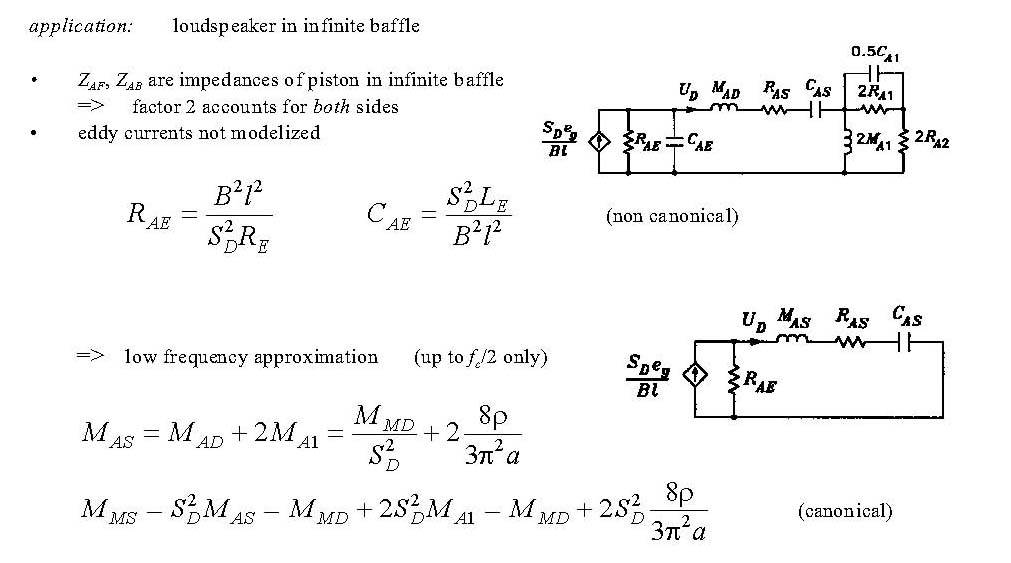
 此主题相关图片如下:
 此主题相关图片如下:
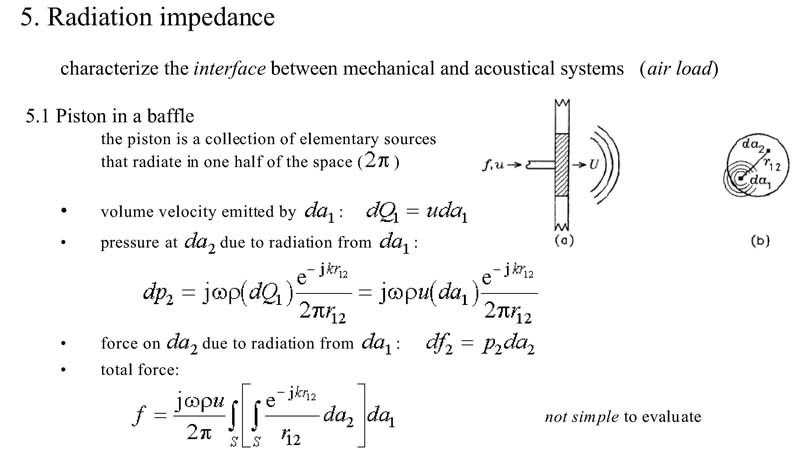 此主题相关图片如下:
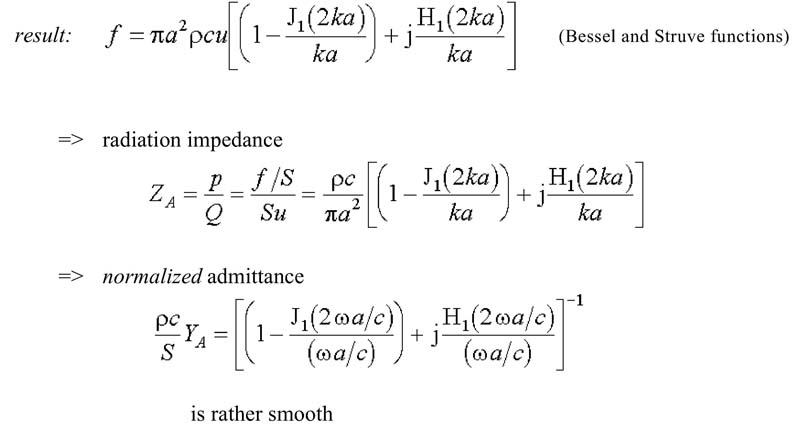 此主题相关图片如下:
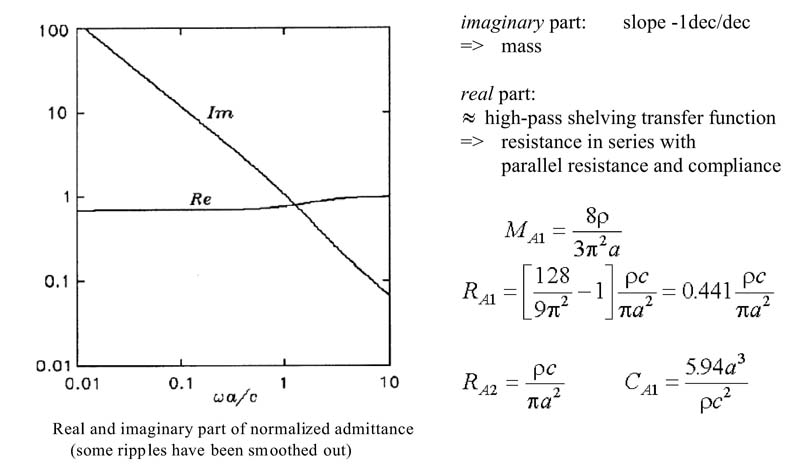 此主题相关图片如下:
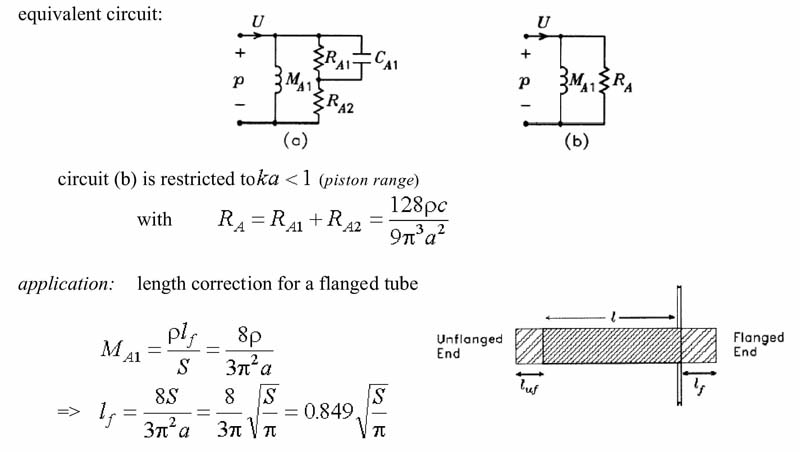 此主题相关图片如下: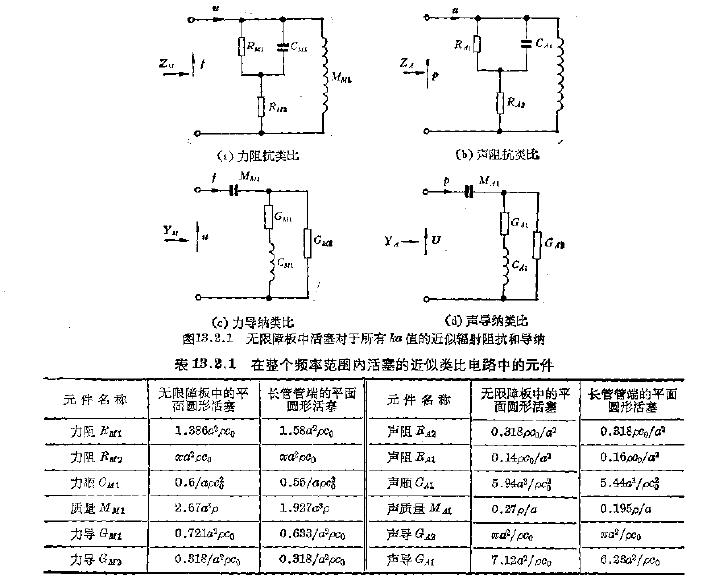
It seems that "Hui4 Geng1 Si1 Yuan2 Li3" was actually used to integrate the synthetic pressure over the piston area.
But I do not quite understand some variables in the formula of section 5.1:
1. Is "u" the particle velocity of the air?
2. What is the variable of "k"?
3. For "pressure at area element da2 due to radiation from da1":
I guess that rho x dQ1 might be the mass element emitted form da1, and the acceleration might be represented as du(t)/dt? I am not sure if this is actually derived from P=F/S=Ma/S=rho*dQ1*du(t)/dt and with the assumption that the velocity is also sinusoidal and that the radiation damps reverse-proportionally with respect to distance r12. Otherwise, how could I interpret the angular frequency omega in that term?
Can I understand that way?
Thanks!
From the surface integral in section 5.1, it seems to me that the integration results might be dependent on the surface shape of the piston area?